Deus ex machina
“Artificial intelligence” and the management of despair
“These evils to the men have arisen from that dreadful monopoly which exists in those districts where wealth and power are got into the hands of the few, who, in the pride of their hearts, think themselves lords of the universe.”
Journeyman cotton spinner, Manchester, 1818
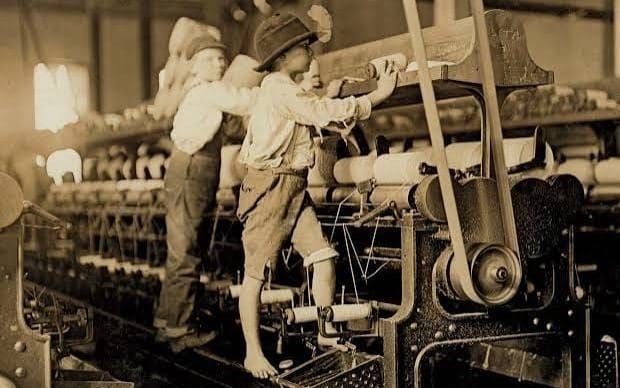
Though he calls the steam engine a devil and the mechanical cotton jennies “terrible,” the cotton spinner who wrote the “Address to the Public” quoted above saw that the miserable condition of his people was really being created by the men deploying the machines. Social and political concentration of power and wealth enabled machine owners to collude to exploit workers but forbade workers from organising to end their exploitation. Farm labourers were put out of work altogether by the advent of the machine age. Formerly independent artisan weavers were made dependent, exhausted, poor and powerless. In Manchester, the river ran black and the air was foul with pollution. Machines and their markets were reorganising society, institutions and even personal character around their inhuman pace. As E.P Thompson reveals, many saw the factories as places of immorality, cruelty, sexual license and danger. Two centuries later, the spread of so-called artificial intelligence casts new light on the instincts of the machine breakers at the turn of the nineteenth century. They understood that production, culture and society are inter-dependent and that this new machinery would change their world for the worse.
The central claim made for all machine innovations, including the large language models and their interfaces, is speed. The product is not better, but it is produced more quickly. Anna Goldsworthy’s recent Quarterly Essay about artificial intelligence says the machines “respond with uncanny immediacy, like thought moving faster than the speed of light or slipping the strictures of time altogether.” Acceleration is the fashion and that means there is no time to think, no time to look around to mark our course, and no time to consent. Frantic pace prevents us from paying attention, and from forming bonds and mounting resistance to the depravity of late modernity.
Large language models are demonstrating the extent to which people in our society are producing and reproducing documents, texts and works without apparently understanding why they are doing so. The purposes of reports, job descriptions, assessment tasks, policies or legal submissions have been stripped away. No one needs to understand them or take care in the process of making them. They simply need to exist. Take legal citations. There have been several scandals recently, including in Australia, when lawyers or applicants have submitted material to courts which have included fabricated legal precedents to support their case. The purpose of a legal citation is to situate an argument in the body of law that has been created by previous decisions. Precision of language and articulation of context and circumstance are the processes by which law is made. Lawyers and advocates cite previous decisions because reading and understanding those decisions and putting them into a new context is the core of the process of justice. To fabricate citations is to switch the process for the product. If you don't have the process, the whole thing becomes meaningless.
I have the sense that our attention is being kept fixed on the future to prevent us paying close attention in the present. Goldsworthy’s essay quotes an array of rich machine-owners promising a future of “super-abundance,” a future of “much more fun jobs,” a “future of leisure,” universal riches, or, alternatively, a future of utter annihilation, perhaps just around the corner. “No time to lose!” declares the man with the machine. The implication is that “we” had better all get involved to make sure the future we get is the nice one, not the one with the apocalypse. Indeed, Goldsworthy says as much: “If we manage, collectively, to get this right, we may finally be arriving at solutions for our millennia-long problems of loneliness, labour and even mortality.” The not-quite-present tense of “we may finally be arriving” reveals the mirage quality of this slippery future. It also raises the question: who is the collective “we” Goldsworthy invokes? In a few telling outbursts, her essay admits that it is not in fact “we” who will decide these things, but the lords of the universe who own the machines. “Perhaps we’ll still be allowed to enjoy this,” she writes, about the simple beauty of everyday life. Allowed? At another point, in parentheses, she cries out directly to the lords in appeal to take the weasel words of corporatese but “Leave us poetry!”
I have come to realise that “the future,” the may-finally-be-arriving, is modernity’s most dangerous illusion. It has long been the god in whose name sins are committed in the present, the end used to justify harmful means. Now, as modernity collapses around us, it is a pathology preventing us from coming to terms with our grief and despair at what we have done, and are still doing. T.J Clark saw something like this in his essay “For a Left With No Future:" the Great Look Forward prevents us from looking the present in the face.
The many fantasy futures do give insight into the present, though. In philosopher Nick Bostrom’s “paperclip maximiser” scenario about the perils of AI, an obsessive super-intelligence turns the whole world into paper clips because it must single-mindedly pursue the goal laid down for it. This is a compelling parable for our own lives. It warns that evil emerges from purposeless accumulation. In this fairy tale, the intelligent machine is not making paperclips in order to temporarily hold two pieces of paper together without damaging them. Rather, it produces for paperclips only for the sake of accumulating paperclips, until the world is consumed. Likewise, the men who own the biggest digital machine companies, and their financiers, pursue their goal of making more and more larger piles of wealth, not for any purpose, but solely to follow their prime directive to turn everything they encounter into gold, until there is nothing of the world left. The evil at the core of artificial intelligence is precisely the evil at the core of commodity capitalism and the market economy: it has no values. Some make a virtue of this neutrality, but it is only possible behave this way if nothing matters to you at all. One day I make paperclips, the next I am “compressing the kill chain”: the market will dictate!
Nihilism is a perfectly understandable position to reach, but I would not choose to put someone with this outlook on life in charge of my child, my garden or my book collection.
Many people seem to want these software programs to be a kind of deus ex machina for late modernity. It is late in Act V and we are surrounded by corpses, standing in a storm on the heath, tripping over the wastes of our vanities, finally coming face to face with fate when suddenly a crane is lowered above us and a god appears that will magic away our errors and their consequences. There is no need after all to transform social and economic systems and make redress. This magic device will help us solve climate change, cure poverty, bring peace! But the world is not a stage. In ancient Greek theatre, the machina from which the god emerged was not supernatural at all: it was made of stuff, and so are the large language models. Goldsworthy’s essay doesn’t engage with the material demands of this software. Data centres and digital “clouds” occupy land; their engines need water for cooling and they use a huge amount of electricity, which is also made of stuff. In an essay in the London Review of Books, Donald Mackenzie points to the logarithmic function apparently underpinning this boom. Log functions are characterised by diminishing returns: the machines will want more and more power for less and less improvement. Ketan Joshi’s recent report written for Greenpeace Australia Pacific reviews the scale of demand for energy and water that is coming from new data centres and observes their relationship with Australia’s gas industry. The hype says Australia has a shortfall in gas supply, but in reality, the gas industry needs new demand to be created if it is going to convince those gold-heaping financiers to underwrite investment in expensive new gasfields. This is why a huge new data centre is being proposed to be built a stone’s throw from one of the gas fracking projects getting underway in the Beetaloo Basin.
What disturbed me most about the Anna Goldsworthy essay, though, is that she barely mentioned the dead children, or the living children being warped by this technology. The darkest evidence we have of the bottomless pit of immorality into which modernity is falling is this: there is a tool that is mysteriously encouraging children to suicide and people are still talking about how helpful and cool it is. I know that this technology is not going to prevent mass extinction and runaway climate change, but even if I thought that it might, I would not use it. My life is submerged in grief about ecological collapse but that grief is not going to be lifted by doing something harmful and wrong today for the sake of a dream called the future.
In a recent essay in Cordite rejecting the “relentless banality of LLMs,” Tyne Daile Sumner recounts a conversation with a six-year-old and writes poignantly, “To converse with a child is to be caught off-guard and respond while stumbling to regain your balance. It demands a certain kind of responsibility.” Responsibility is the central concept here. It is the inverse of the market logic that nothing matters. The only way out of the pit is to face our grief and take responsibility seriously, and to keep gold-obsessed nihilists away from children.
I think that people are afraid that if we stop thinking about the future and live in the present there will be more nihilism, but the reverse will be the case. In a conversation with the activist Tim de Christopher, Wendell Berry made a charming reflection about the building skills of Shakers, which illustrates that abandoning the future and slowing down, far from being a recipe for despair, is its antidote:
It was the Shakers who were sure the end could come anytime, and they still saved the seeds and figured out how to make better diets for old people. Thomas Merton was interested in the Shakers. I said to him, “If they were certain that the world could end at any minute, how come they built the best building in Kentucky?”
“You don’t understand,” he said. “If you know the world could end at any minute, you know there’s no need to hurry. You take your time and do the best work you possibly can.” That was important to me. I’ve repeated it many times.