The art of collapse
We lack the language to express what is happening to us. Our welter of words and images do not convey the monstrosity, the gravity of our predicament or its pathos. The vocabularies of economics, politics, psychoanalysis and science fall short. They are not vast enough, ancient enough or common enough to meet our need. Co-lapse means falling together and it is this sense of ourselves as social, collective and communal for which we grope.
As the tragedy unfolds, the urge to make sense and find meaning must wait. Let the shared dark speak first.
The Pietà and the suffering that cannot be mended
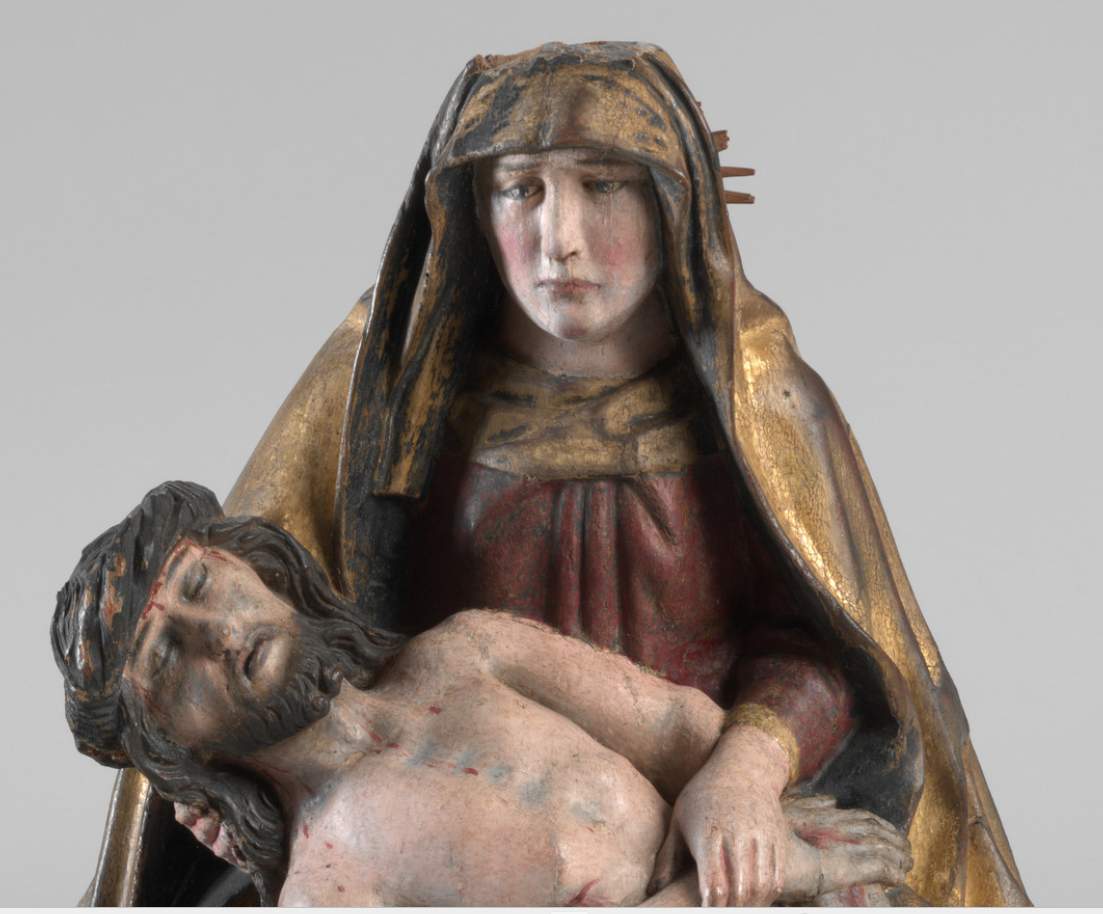
At the NGV in Melbourne, the anguished face of a sixteenth-century German Pietà, carved in limewood, is framed by the folds of robes collapsing around her. They bend like a river of time, isolating her. She stares vacantly, but is nonetheless acutely present in devastation as she cradles her dead son. This is not a scene from the Bible: the Pietà is an imagined icon of suffering, distilled and extracted from her story. Stripped of context, she is pure, solid desolation, dense as petrified wood. (De-solate: to make solitary, to leave alone).
Theodore Adorno wrote, “Something in reality rebuffs rational knowledge. Suffering remains foreign to knowledge,” but in the tradition we inherit from the scientific revolution, the realms beyond knowledge are taboo. If there is suffering, there must be an inquiry to examine the evidence and determine suffering’s causes and remedies and make recommendations for policy or technology that will fix the suffering and make everything okay…
Everything is not going to be okay.
How will we accommodate the vastness of so much irrevocable loss, so much shame and sorrow into everyday life, as we live through the collapse not just of this civilisation, but of so much beauty, abundance and complexity in the natural world? The Pietà depicts this suffering that cannot be mended. She is the inconsolable.
The Pietà is on display in a floor dedicated to European art from before the twentieth century. Much of this work is intimate and harrowing. Sculptures and paintings depict weeping women, faces raised to the sky, and the bleeding corpse of a betrayed god whose agony is his most holy gift. The European works confront the visitor as the products of a people preoccupied with suffering in its most intimate form.
On the floor above, there is a collection of historic art from Asia featuring dancing tree-gods, serene Bodhisattvas, and marvellous invocations of a living, turning world. In contrast to those on the floor below, the Asian works strike me as cosmic and celebratory, even when they feature human figures being humbled by supernatural forces. The Asian works, diverse as they are in their origins from Indonesia to China, do not seem preoccupied by the personal.
The curation of these works in their stacked floors illuminates something about art during our collapse, how we might draw on the contrasting perspectives of these traditions to grapple with what is being done to the world and what the world is doing in return. The world beyond the self will become newly adamant, mysterious and implacable and we will need new-old forms of expression to live together in it. The personal will remain in the foreground but will be illuminated by forces and processes whose scale requires a collective sense of selfhood to emerge as we lament and tremble, as we say to each other, “We have done this, to our sorrow.”
A kind of synthesis of the cosmic, social, natural and personal beckons, but we will not rationalise our way into it.
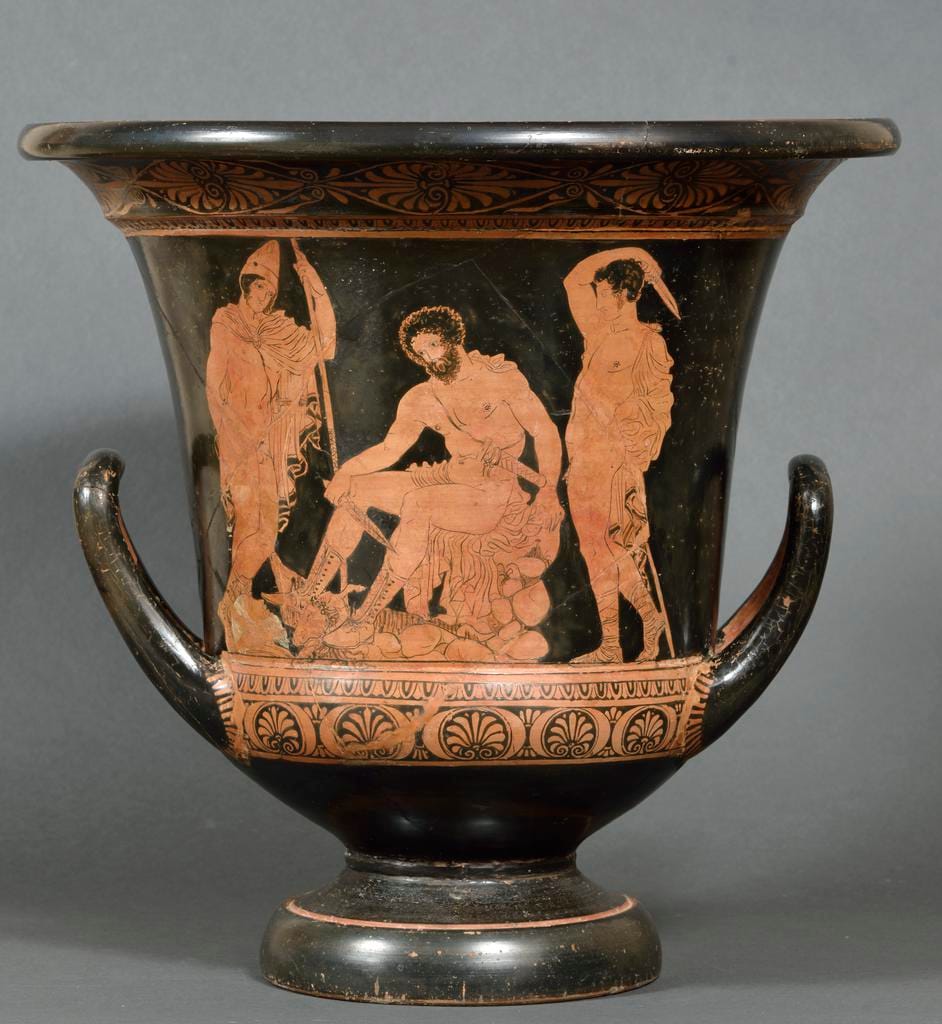
In Euripides’ Trojan Women, the elite women of the fallen city lament the dead and their imminent enslavement: all overturned, Hecuba says. The play has little action, but the women pass through a series of episodes of mourning, revealing their fate and the fate of those they love, singing, resisting and rehearsing their despair. Some tragic protagonists are condemned by their own actions as those actions return upon them in unstoppable consequences. The Trojan women are simply borne on the turning wheel, unable to control what is taking place or protect and hold what they love.
Ancient tragedy marked a transition from the epic and heroic age that was characterised by the forces of fate, nature and the gods, into a civilised age organised around law, society and the self. In our own time, the consequences circling darkly in the sky above us promise a reversal of that movement. The tower cracks and sways, but is not yet fallen. The wheel turns but we have not yet accepted again our place in a vast planetary complex that we cannot control and barely understand.
There is meaning, but not for us…
At this late stage of cracked modernity, making poetry, art or music that expresses a common life seems out of reach, but, equally, individual meaning-making will not suffice as society collapses. Geology, history, epic floods, climate change – these forces and processes are too big for an individual (desolated, solitary) to grasp. Some things can only be understood communally.
When Australia’s National Climate Risk Assessment (NCRA) was released last year it illuminated the interconnecting consequences of climate change for Australian ecosystems and society and gestured to the process of collapse. The NCRA is striking in its recognition of culture as an Aboriginal phenomenon on this continent and in its silence about a cultural life for the rest of us. The assessment recognises the particular threat climate change poses to cultural practices and connections in Aboriginal and Torres Strait Islander communities, given that First Nations cultures are embedded in Country and its ecosystems. For settlers and their descendants, in contrast, there is the economy, assets, productivity and supply chains. This contrast reminded me of something Alexis Wright wrote about the persistence of Aboriginal sovereignty in “an Australia that is basically one homogenous cultureless society where people come to live and leave their cultural origins elsewhere” (see “Dream Geographies” here).
The NCRA does briefly acknowledge that the country means more to us than money:
predicted change in ecosystems is likely to put additional pressure on mental health and wellbeing issues as Australians grapple with the loss of familiar ecosystems and species. They will need to come to terms with dead and dying trees, other plants and animals across the nation as ecosystems transition, face new challenges in the new environments, and overcome the loss of critical ecosystem function.
We who are distressed about vanished kelp, collapsing rivers, burnt forests and bats falling from the canopy as their little bodies overheat, recognise ourselves in these words, but can we find community in it? Can we fill the hole in our sense of ourselves as more than economic consumers and producers while also honouring Aboriginal sovereignty and continuing culture? For those Australians, like me, whose cultures are inherited from distant lands, these feelings are personal, not collective. For now.
Wright posed another question in the same essay: was it desire rather than hope that ensured the survival of the longest living culture in the world? Desire for the beauty and vividness of the living world. Desire for connection. Aboriginal survival has already endured climate change, including dramatic sea-level rise that is still recalled by stories in 29 different places around the coast of the continent (see Reid et al, in “Deep Water Knowledge,” here). It has spanned the cataclysm of invasion and colonisation – a process that resembles what we mean when we say collapse. It may well be desire, rather than hope, that carries us through the next upheaval and that our descendants cite in seven thousand years as creating the conditions for their survival.
At the seawall: the thrill of collapse
My own people have an ambiguous relationship with civilisational collapse because generations of us have longed for it.
Alongside the industrial revolution, a resistant counter-cultural tradition was initiated that we give the name Romanticism. It takes many forms, but it has persisted alongside modernity as a sort of pea under the mattress of material comfort: “The Romantic vision is characterized by the painful and melancholic conviction that in modern reality something precious has been lost, at the level of both individuals and humanity at large” (Lowy and Sayre, in this great book).
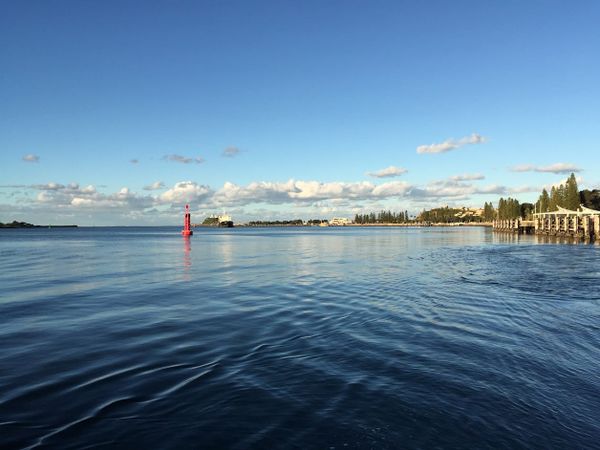
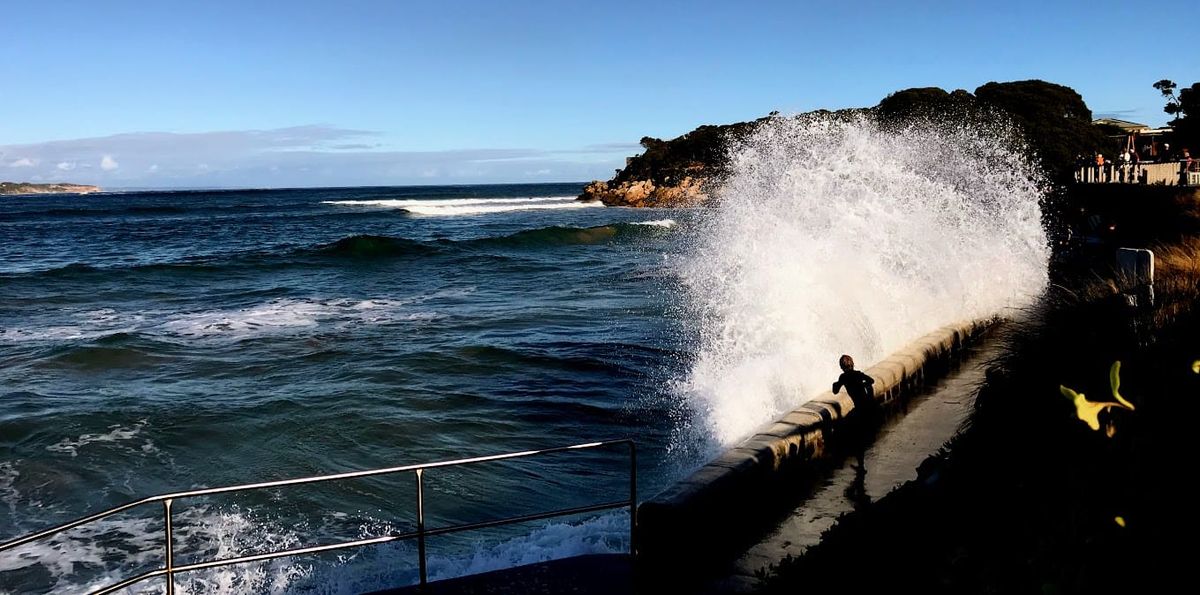
Something of the Romantic spirit grips children during high tide in the seaside village where I live. A wall with jutting groynes has been built around the bay. When the swell and tide are up, waves smash into this wall and create a thrilling spectacle. Children love standing at the edge of the safe, built world as the waves break onto it, rear up, collapse and drench them. I like to watch them doing this. I have always liked watching waves throwing themselves against concrete walls. I know I am a Romantic because I feel loyal to the water, not the walls.
People want to be tested and feel the weight of their choices, but fear rises up with the wave: what are we without that wall? What would we be without this economy, these properties and supply chains? Since Thomas Hobbes, a story has been told and retold that this civilisation and its organising principles of private property and authority are a wall we built against the barbarism of the human animal. This story insists that as things fall apart we will collapse into Hobbes’ war of all against all. It is reproduced daily in our society in our obsession with crime stories and in the way we talk about each other and the natural world as competitive and unforgiving. It is the chief source of the fear that stymies imaginative and transformative responses to climate change.
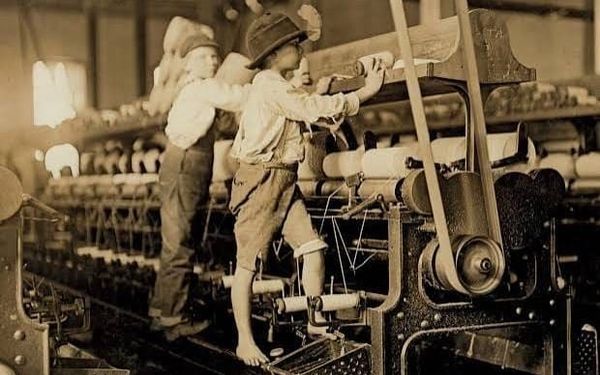
That story serves the interests of the powerful. It denies people’s experience of their communities and their own desire to connect, share and live in peace. That story also suppresses and denies what people intuitively know about the society we live in: that this system itself produces the war of all against all and cultivates self-interest as its chief cultural logic. Civilisation is not protecting us from violence: it is reproducing it. Luxury’s existence creates its opposite, suffering and degradation. Growth presupposes theft.
Writing of white North Americans, Adrienne Rich wrote,
“…as a people we have rarely, if ever, known what it is to tremble with fear, to lament, to rage, to praise, to solemnize, to say We have done this, to our sorrow; to say Enough, to say We will, to say We will not. To lay claim to poetry”
Laying claim to poetry demands a reckoning. To get home, you must sail into the underworld, cut and release your own blood and ask the blind prophet the question we fear most, “On whose suffering does my relative peace and plenty depend?” As a society, we have been too afraid to ask this, and hear the answer, but the question is being taken out of our hands.
Only connect
Late in the writing of this piece, news arrived that Wendell Berry had died. His 1987 essay “Writer and region” turns on a masterful analysis of Huckleberry Finn and the immaturity of American notions of freedom that romanticise the irresponsibility of solitude and are incapable of imagining a community life. As a counterpoint, Berry wrote that community life is tragic, “because it involves unremittingly the need to survive mortality, partiality, and evil.” He goes on:
Because Huck Finn and Mark Twain so clung to boyhood, and to the boy’s vision of free bachelorhood, neither could enter community life as I am attempting to understand it. A boy can experience grief and horror, but he cannot experience that fulfillment and catharsis of grief, fear, and pity that we call tragedy and still remain a boy. Nor can he experience tragedy in solitude or as a stranger, for tragedy is experienceable only in the context of a beloved community. The fulfillment and catharsis that Aristotle described as the communal result of tragic drama is an artificial enactment of the way a mature community survives tragedy in fact.
His invocation of “community” here need not be exclusively human, or even exclusively alive. Berry wrote about rivers, mountains, birds and soils as constituents of his community. Our tragedy is that we are in community without seeing and feeling it, without accessing the language and forms of living that give expression to it and without being able to access, in turn, the enlargement of self, the breadth of sight, that it enables.
We will only really know climate change, both what it is and what we shall do in response to it, through a collective experience of the Earth’s processes and the grief, pity and fear those processes evoke in us.
We fall together. In the havoc, for a while, there may depiction without interpretation. The forms of expression we’ve grown used to, our politics, our science, our psychoanalysis, will fail in stages, like the walls themselves, and it will be some time, maybe many generations, before the new knowing can be clearly spoken.
The eorþan modor in her Pietà guise cradles the slain, but his eyes are closed: he is insensible to her embrace.
Breaking on the wall, the wave falls apart into countless wobbling globs that erupt and then hang in the air before raining down and reforming as one.
Old stories tell of turning wheels: all things pass, they say. People are paltry in storm’s-path and once-familiar country can drown under rising seas. None of this is sense-making, really, but it is life-making and community-making. Turn is a much older word in English than change and it augurs movement and renewal.
Imagine then, what you desire: that you can live free, feed and give shelter to your children and have plenty of time for shared social activity and creative expression, knowing where your food and water come from and where your shit and bones go, knowing the patterns of wind, rain and light in the land that holds you, knowing by name, habit and relationship the other creatures with whom you share land, sky and water. Imagine cultural expression as a cohesive force, a river connecting our imaginative and material life and giving expression to our shared grief, our shame, our fear and our joy. Imagine that art need no longer burn up its energies in protest against its own society, but come again to express wider and deeper things that are true. It is not merely possible, it is the only way to survive.